Modeling the Role of Graphical and Textual Complexity in Geometry
Problem-Solving Using SEM.
Farshid Farzan, Canwen Wang, Rachel L Ankney, Paulo Carvalho
last updated-Nov.2025
last updated-Nov.2025
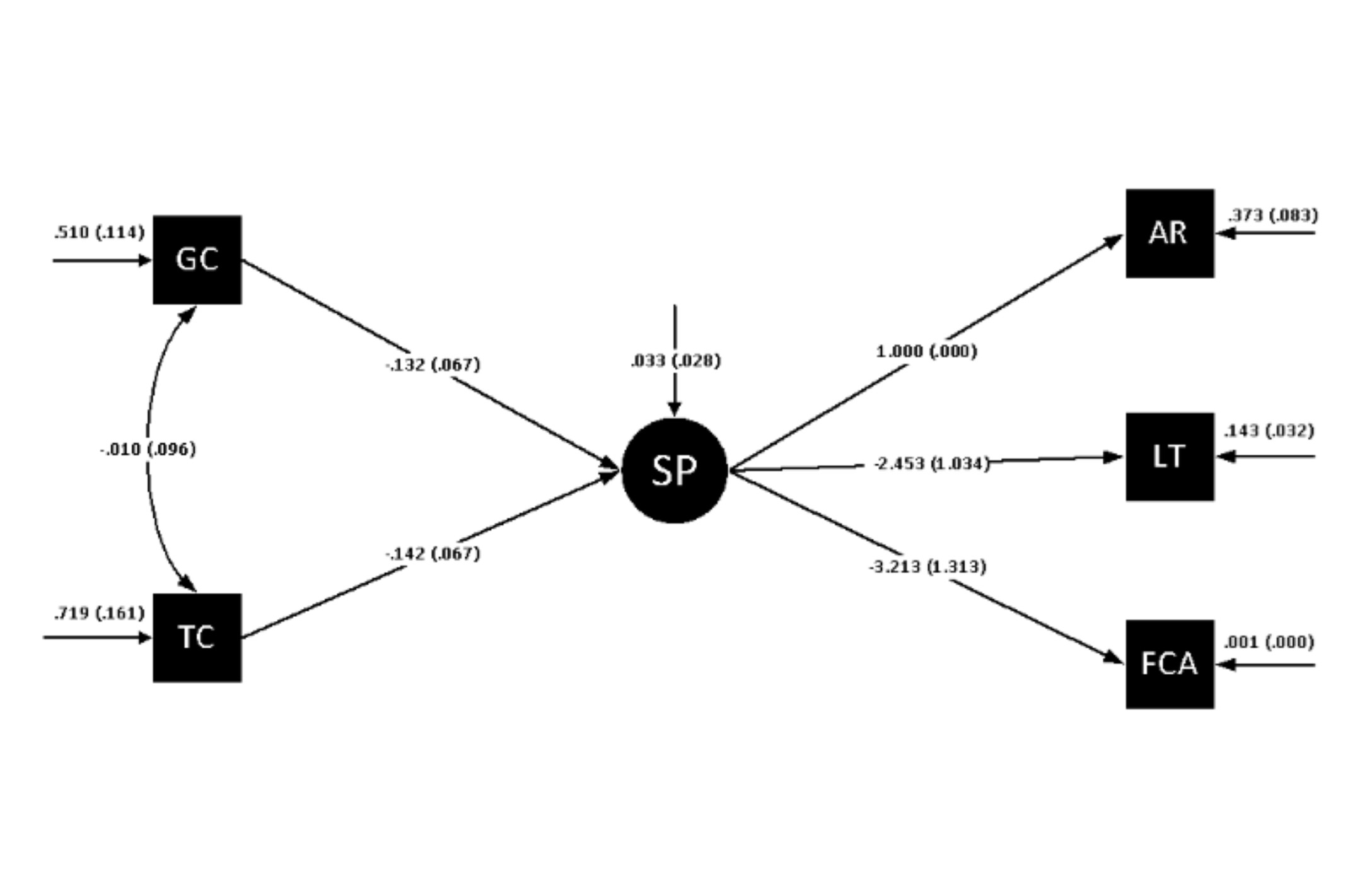
Learning geometry is vital for K–12 students, fostering spatial reasoning and problem-solving skills crucial in STEM fields. However, its abstract nature, reliance on visualization, deductive reasoning, and specific vocabulary make it challenging. Cognitive Load Theory explains how excessive graphical and textual complexity can overwhelm working memory, impeding learning. The revised Cognitive Load Theory framework highlights the importance of directing cognitive effort toward meaningful schema construction (germane processing) rather than being hindered by extraneous load. This study uses Structural Equation Modeling (SEM) to examine how structural complexity (graphical and textual complexity) affects student performance in geometry learning, modeled as a latent variable measured by accuracy, latency, and first correct attempt. Forty geometry questions exam answered by 59 students from the 1996–97 Cognitive Tutor dataset (DataShop) were analyzed to examine how graphical and textual complexity influenced student performance. Each question systematically varied in complexity, and student performance was measured using accuracy rate, latency, and first correct attempt, well-established metrics in educational research. Student Performance is conceptualized as a latent variable measured by Accuracy Rate, Latency, and First Correct Attempt. Graphical Complexity and Textual Complexity serve as observed variables. Employing a two-phase SEM approach, the study evaluates both measurement and structural models. The findings reveal that Graphical Complexity and Textual Complexity significantly and negatively influence student performance overall, with unstandardized regression coefficients of -.132 and -.142, respectively, and explain 40.9% of the variance in SP. However, contrary to the initial understanding that it seems the higher complexity may lead to initial wrong answers, higher levels of Graphical Complexity and Textual Complexity were associated with increased First Correct Attempt, suggesting that complexity may promote deeper cognitive engagement in some contexts aligned with Cognitive Load Theory, highlighting both the detrimental effects of complexity on efficiency and the potential benefits for accuracy in problem-solving.
The 2nd International Conference on Education Research (ICER 2025)